Team messaging platform first: why Workchats is not a suite
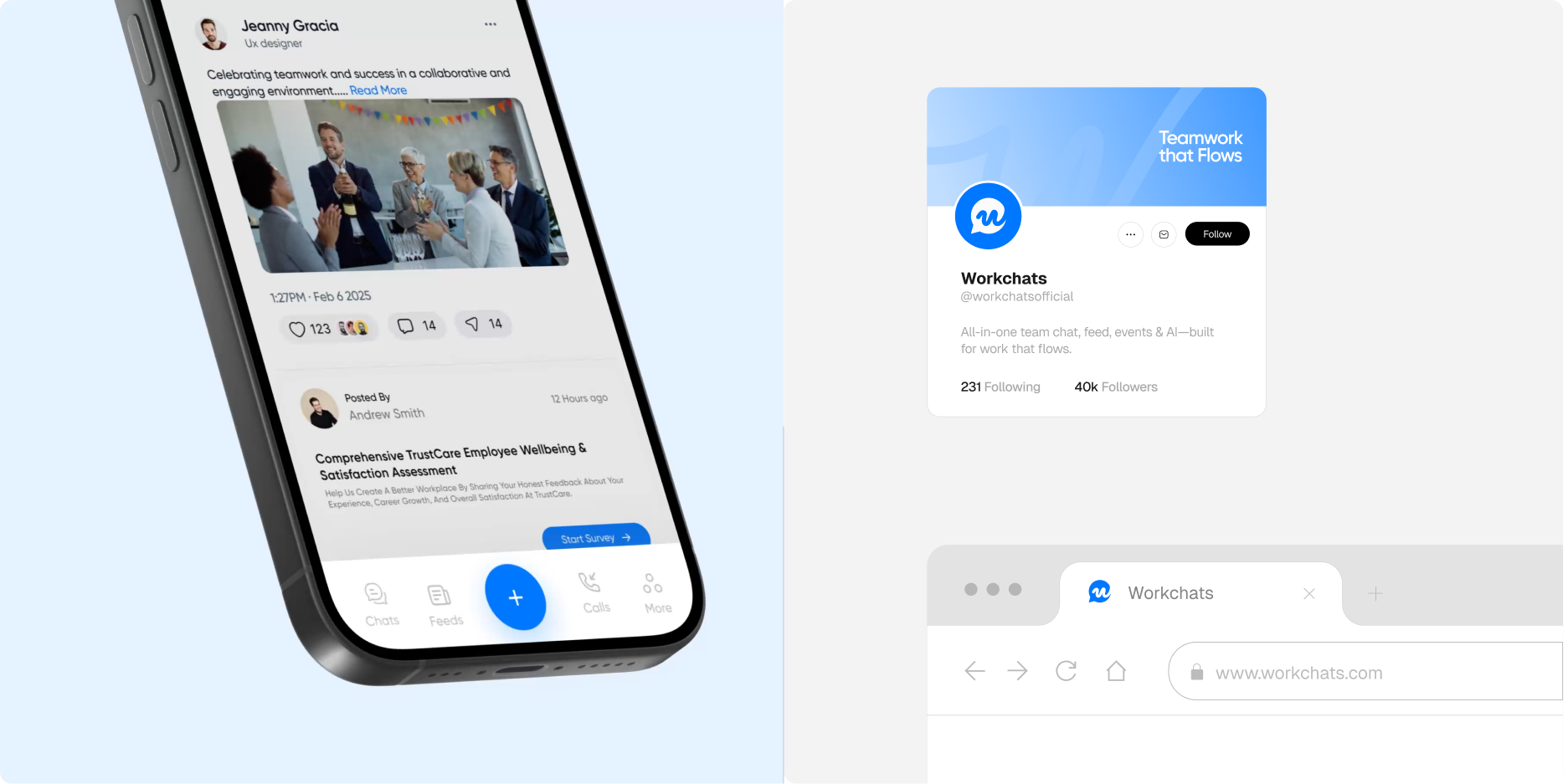
Most workplace tools pitched to you this quarter will promise to be everything at once: messaging, video, tasks, files, tickets, docs, HR. The pitch is that one tool replaces five. The price tag reflects it. WorkChats is not that tool. It is a team messaging platform first, then voice and video, then file sharing. That is the stack, in that order of emphasis.
If you have not seen it yet, you can explore the full Workchats platform and how messaging, meetings, files, and search come together in one place.
There is a reason for the ordering, and it is the heart of how the product was built.
The case for doing one job well is unfashionable in a market that rewards suite claims. It is also the case that fits how most SMBs and mid-market teams actually work: they already have an email tool, a calendar, a doc tool, maybe a CRM, and they want their chat layer to stop being the weak link. They do not want to rip out their stack. They want one thing to work better.
This post explains why WorkChats leads with messaging, what that means for product decisions, and why Founding Members during early access get a sharper tool, not a broader one. Read the full feature list on the messaging page.
"Doing one job well beats doing five jobs adequately. WorkChats is a team messaging platform first. Video and files support that job, they do not distract from it."
The product decisions that follow from 'messaging first' are different from the ones that follow from 'suite'.
Why a team messaging platform, not a suite
Suite pitches sound sensible in a deck. In practice, they create a specific failure mode: every feature is present, none is sharp. The calendar works, but not as well as Google Calendar. The docs are fine, but not as good as Notion. The video calling is included, but not the default choice when the meeting matters.
The teams WorkChats is built for (10 to 500 people, UK, EU, and Middle East, in care, hospitality, retail, construction, recruitment, and professional services) do not need another half-good calendar. They need their chat layer to do three things exceptionally well: carry messages, carry meetings, and find things.
That is the scope. Everything else is a distraction from that scope.
What "messaging first" means for product decisions
Saying "messaging first" would be marketing noise if it did not show up in the product. Here is how it changes what gets built, and what does not.
Built in because messaging needs them
- DMs, groups, and channels with threads, reactions, voice notes, and file attachments. The baseline.
- End-to-end encryption, offline support, and global search. These are the features that make messaging trustworthy at work.
- Voice and video calls attached directly to a conversation. You click the person you are already messaging. You do not open a second app.
- Screen sharing, meeting recordings, and AI-generated meeting summaries. Meetings are an extension of conversations, so they live in the same product.
- File sharing with 5 GB to 50 GB per user. Files get shared inside conversations, so storage lives next to the chat, not in a fifth app.
- Working hours, multi-company switching, and a calendar. Each one exists to make messaging behave properly when the team is spread across time zones and companies.
Deliberately not at launch
- A social feed. Designed, scoped, and coming after launch, not on day one.
- Event management. Designed, coming after launch.
- Polls and surveys. Designed, coming after launch.
- An AI Filing Cabinet. Planned, not shipping at launch.
- A broad third-party integration marketplace. Launch integrations focus on calendar (Google, Outlook, iCal) and email. The wider ecosystem is post-launch.
The coming-after-launch list is not an apology. It is a decision. A team messaging platform that tried to also be a social network and an events tool on day one would be a worse messaging tool.
Who benefits from a sharper tool
Three audiences gain the most from the messaging-first approach.
- Operations leads in SMBs who want fewer dashboards and one accurate source of truth for team chat, not a new CRM layer or a new doc system.
- IT decision makers in 10 to 500 person companies who need a tool with SSO, audit logs, and a manageable security surface area, without paying enterprise rates for features that belong in mid-market.
- Founders and CEOs who know the chat tool is the nervous system of the company and are tired of it being the weak link.
The team on the other side of this (Octogle Technologies, based in Dubai, with engineering in Pune and commercial in the UK) is building for those three personas. Not for a 10,000-seat enterprise with 17 federated IT teams.
How "messaging first" changes the price
Focus has a price benefit. WorkChats Pro is £3 per user per month on annual billing. Suite tools that try to do everything charge for everything. Slack Pro, at £7.25 per user per month, is a 59% premium on focused messaging. Microsoft 365 Business Standard, which bundles messaging into a broader suite, is roughly £10.30 per user per month.
The right comparison is not "who is cheapest" but "what am I paying for, and is it sharp". Paying £10 a seat for a mediocre chat layer bundled with Word and Excel is fine if you need Word and Excel. It is a bad deal if what you actually want is a chat tool that works. You can see all WorkChats plans, including the Free tier for teams up to five, on the pricing page.
FAQ
Is WorkChats really just a chat app?
Not quite. It is a team messaging platform, plus voice and video, plus file sharing, plus global search, plus a calendar. What it is not is a doc tool, a CRM, an HR tool, or a ticketing system. Those jobs belong to products that do them well.
Will WorkChats add more features over time?
Yes, but only the ones that support the messaging job. Social Feed, Events, Polls, and an AI Filing Cabinet are designed and coming after launch. A CRM or a task manager is not on the roadmap.
Why should I care about "messaging first" as a buyer?
Because the product decisions it implies (fewer distractions, faster search, lower price, smaller security surface) affect your team every day. A focused tool is cheaper to run and easier to adopt than a suite your team will only use 30% of.
Next step
If your team wants a team messaging platform that picks its battles, early access is open now. Founding Members lock in £3 Pro pricing for the life of their account, and Free stays free for teams up to five.